
Read Barbour Property Tax Records
The public Barbour CAMA system connects each parcel to its land, building and appraised totals. Its dashboard can also surface Assessment, Collections, BOE, Legal, Permits, Documents and Maps views. Check the tax year first. Values and exemptions may shift from one year to the next.
| Field | What It Shows | Where |
|---|---|---|
| Assessed value | Class-adjusted taxable base | CAMA Assessment |
| Market / appraised value | County appraisal before class ratio | CAMA parcel card |
| Exemptions | Approved homestead relief | Revenue Commissioner |
| Tax bill & status | Receipts and payment history when available | CAMA Collections or Revenue staff |
| Tax district | County or municipal assessment district | CAMA parcel card |
Appraised value is the county's estimate before the class ratio applies. Assessed value is the class-adjusted base that feeds the tax formula. Approved exemptions then reduce taxable value. None of these figures promises a sale price. The Barbour County property value explanation separates those terms without rebuilding the tax-bill process.
Trace a Barbour Tax Account
Barbour County publishes no separate public tax-bill URL. Instead, search CAMA for the parcel and open any Collections or receipt links that appear. For a current balance or certified record, contact the Revenue Commissioner directly. Eufaula appraisal staff answer at 334-687-7630, and Clayton appraisal staff at 334-775-1112.
- Search CAMA by physical address or exact parcel number and confirm the owner, district and tax year.
- Review Assessment for appraised and assessed figures, then inspect Collections for any public receipt history.
- Check the parcel for applied exemptions and ask Revenue staff about any missing or unclear entry.
- Use Alabama DOR delinquent-property sources when the account may have entered the tax-sale process.
- Assessed value
- The appraised value after the legal class ratio is applied.
- Mill rate or levy
- The rate applied to taxable assessed value to calculate tax.
- Homestead exemption
- Relief available to an eligible owner-occupied principal home.
- Tax lien
- A claim tied to land because property tax remains unpaid.
Search Barbour Assessment Fields
Barbour's Basic Search reaches beyond address and parcel number. Filters include owner, mailing address, district, and subdivision. They also cover acreage range, total value range, deed book and page, deed date, and section-township-range. The separate Land Search adds land method, forest-land, schedule, unit-price and quantity fields. Improvement Search rounds it out with building type, description, condition, value, size and dimensions.
| Search control | Use in a tax review |
|---|---|
| Location | Find the physical property |
| Parcel number | Open the exact assessment unit |
| District | Narrow the county area |
| Total value range | Compare parcels by appraised amount |
| Deed book/page | Match the roll to its recorded transfer clue |
Alabama DOR's county directory lists the Barbour Revenue Commissioner and appraisal contacts. It publishes no separate local certified-copy fee or fixed roll-refresh calendar.
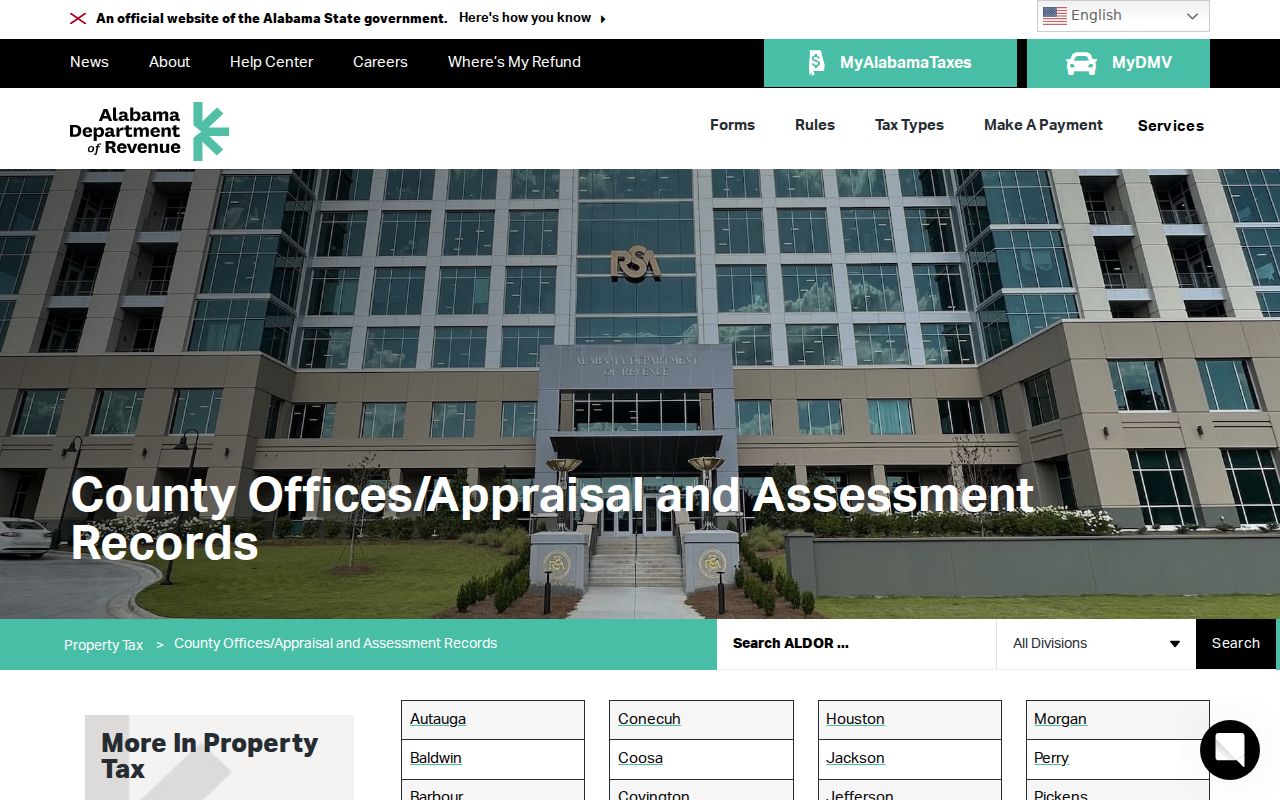
The state directory is the official route to the county appraisal office and its public property tools.
Barbour Tax Value Classes
Alabama property-tax assessment rules separate market or current-use value from assessed value. Class III covers agricultural, forest and single-family owner-occupied residential property under state rules. Current-use treatment can value qualifying farm or forest land by use. It departs from ordinary market assumptions. Always check the parcel classification before comparing two assessed values.
Alabama's 7% cap limits yearly growth in taxable assessed value for qualifying Class II and III real property. Listed exceptions apply. It does not freeze appraised market value. It does not erase tax or guarantee the same bill. New construction, a class change, a transfer or another statutory exception can alter the math. Read both the uncapped appraisal fields and the taxable result together.
Work through the assessment in stages. First identify the market value or an approved current-use value. Next confirm the legal class ratio used to reach assessed value. Then apply the cap and exemptions before rates enter. Two nearby parcels with similar buildings can carry different taxable amounts. Class, use and exemption facts differ. Barbour Revenue staff can pinpoint which entries apply for the tax year in question.
Current use matters across Barbour County's farm and forest landscape. It is a statutory method for qualifying land. It is not a blanket discount on every rural tract. Confirm the land-use entry, application status and year. A later change in use can end the treatment. An old parcel card cannot safely predict a present property tax bill.
Barbour Homestead Tax Records
The Alabama DOR homestead page lays out the H-1 through H-4 categories. It also covers other exemption rules. Eligibility turns on the home, the occupancy and each category's legal requirements. An exemption on one year's Barbour County property tax record should never be assumed for a later year. It should not be assumed for a different parcel either.
Ask Revenue staff which proof and filing path apply. Keep the parcel ID and assessment notice at hand. If an expected exemption is missing, find out whether the issue is eligibility. It may instead be an application step or a data error. Never infer approval from age, a mailing address or a prior owner's record.
Exemption questions show why owner and mailing fields demand care. CAMA links the mailing address to the most recent deed affecting the parcel. That line does not prove principal residence. Revenue staff decide whether submitted facts meet a category. File any approval notice with the annual property tax records. A missing benefit can then be traced to the right year.
Barbour Parcel Card Numbers
A public sample parcel card splits out $800 in land. It shows $0 in building value. Its appraised value is $800. An official Eufaula weed-abatement record shows another parcel with a blank property address and a 1973 deed reference. The same record lists $6,000 land, $0 building, and $6,000 appraised value. It also carries $51 annual tax and payment-history lines. These are samples of the fields. They are not current tax quotes.
View the Barbour sample CAMA record. See how parcel, deed, and value fields sit together.
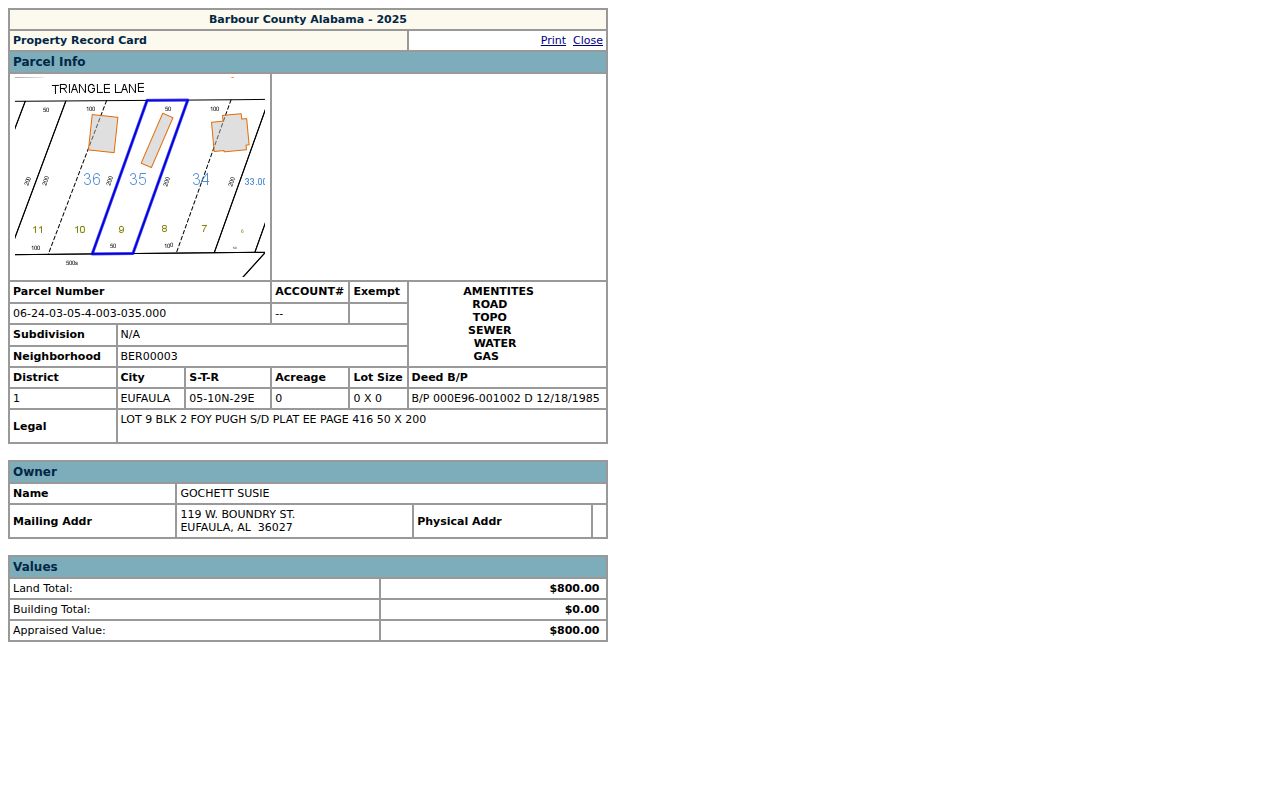
The example shows why land, building and total appraised amounts belong in separate entries.
Barbour Delinquent Property Tax
Alabama sells tax-delinquent land through a set process. The Alabama DOR delinquent-property page lays out the county transcript routes and explains how the state prices its holdings. Transcripts are refreshed weekly. They may still lack a street address. The Book of Lands sits open for inspection, and Alabama holds its land auctions roughly once a year. Remember that a listing or certificate alone never proves ownership transferred.
Timing matters with state-held certificates. A certificate under three years old can be assigned. After three years, the state may issue a tax deed. Neither document hands you clear title on its own. Redemption rights, other liens, and later conveyances all need checking first. Paying a stranger's tax bill creates no ownership either.
A real delinquent-tax review goes beyond the transcript. Match its parcel key to the CAMA record. Ask the Revenue Commissioner for current status on the parcel. Search Probate for any tax deed, redemption instrument, or later deed. When litigation touches the land, the Circuit Clerk may hold the case file while Probate keeps the recorded notice or resulting deed. Log every date separately. The transcript date is not always the sale date.
Contest a Barbour Assessment
Alabama DOR gives taxpayers a clear path to dispute a value. A written protest goes to the county Board of Equalization within 30 calendar days after the valuation notice. Before filing, compare the parcel facts, land and improvement entries, classification, and exemption status. Keep the notice itself. Its date starts the clock.
Appeal window. File the written Barbour County Board of Equalization protest within 30 calendar days after the valuation notice.
Good evidence speaks to the specific parcel and valuation date. Check acreage, land use, building facts, condition, classification, and comparable property data. Include any current-use entry too. A deed price alone can reflect terms that never match the county appraisal date. File the written protest on time even if documents are still coming together. Follow the Board's instructions from there. State guidance points taxpayers to the local assessing official. It names the Board of Equalization, not an informal web correction.
Build a dated file as you go. Keep the CAMA card and the valuation notice. Keep photographs and any records that support a factual challenge. An error in square footage or building condition is a factual issue. Disputing the county's valuation judgment is a different matter. The proof for each differs. A parcel recently split, combined, or improved deserves extra care. Attach the deed, plat, permit, or survey that explains the change. Ask how and when the Board will issue its decision. Confirm any further appeal route from the official notice. Barbour publishes no different local deadline. The Alabama 30-day rule therefore remains the safe filing guide.
A winning protest adjusts the assessment. It does not touch recorded title. No deed gets rewritten, no parcel line moves, and no tax lien disappears. Ownership and legal-description errors belong with the office that keeps those records. Route each correction to its custodian. That keeps a tax protest from standing in for Probate or survey work.