
Barbour Deed Types and Uses
The Barbour County Probate Office records documents that transfer or burden real property. A 2025 eRecording bulletin supplies the local vocabulary of instrument types. The label matters. A warranty deed, corrective deed, foreclosure deed, easement, or fiduciary deed can each mark a very different event. The property records tell the story.
| Deed Type | What It Does | Common Use |
|---|---|---|
| Statutory or special warranty | Conveys land with stated covenants | Sale or negotiated transfer |
| Quit claim | Transfers the grantor's claimed interest | Interest release or title cleanup |
| Executor, trustee, or fiduciary | Transfers through an authorized representative | Estate, trust, or court-linked transfer |
| Corrective deed | Corrects a recorded instrument | Name, recital, or description correction |
| Easement or right of way | Grants a limited land use | Access, utilities, or passage |
| Foreclosure or redemption | Records a distressed-property event | Foreclosure transfer or recovery |
Mineral, timber, tax, sheriff, and commissioner deeds appear too. So do life estate, survivorship, and personal-representative deeds. Mortgages and liens burden an interest rather than transfer full ownership, and their releases or satisfactions should be traced alongside the deed chain.
Barbour Probate Is the Recorder
Alabama assigns Barbour County land recording to no separate county clerk. The Judge of Probate holds the job. Deeds, mortgages, liens, plats, and easements live there. Clayton's office is at 1 Court Square, Room 201, phone 334-775-8371. Eufaula keeps a service point at 405 East Barbour Street, phone 334-687-1530.
Weekday hours run 8:00 a.m. to 4:30 p.m. according to the official recording page. Eufaula title processing ends at 4:00 p.m. sharp. That earlier cutoff matters. A same-day copy or recording question needs staff help at the counter.
Note: Call before travel first. An older book, plat, or certified copy may take time to pull.
Search Barbour Recorded Instruments
The ING Probate portal bundles three searches. Land, probate-case, and marriage records sit behind it, with document access requiring a free account or the Pay-Per-Document route. The Probate Office stays the custodian.
| Control | Purpose | Useful tactic |
|---|---|---|
| Search type | Choose name, date, or book/page | Use the strongest known reference |
| Party role | Grantor, grantee, assignee, or all | Change roles when a transfer is missed |
| Starts With | Matches opening text | Test surname and entity variants |
| Instrument Type | Filters record classes | Select one or several types |
| Date range | Limits recording dates | Widen it for late recordings |
| Book/Page | Targets a known citation | Carry it from CAMA or a prior deed |
Results can be filtered and sorted. Condensed or list views are available. The condensed view may show only the first grantor and grantee until all indexed names open, and cross-references can connect a correction, assignment, or release.
Barbour Deed Portal View
The public landing screen confirms which categories are online without promising full historical coverage of the deed records. Start at the Barbour ING Probate entry page.
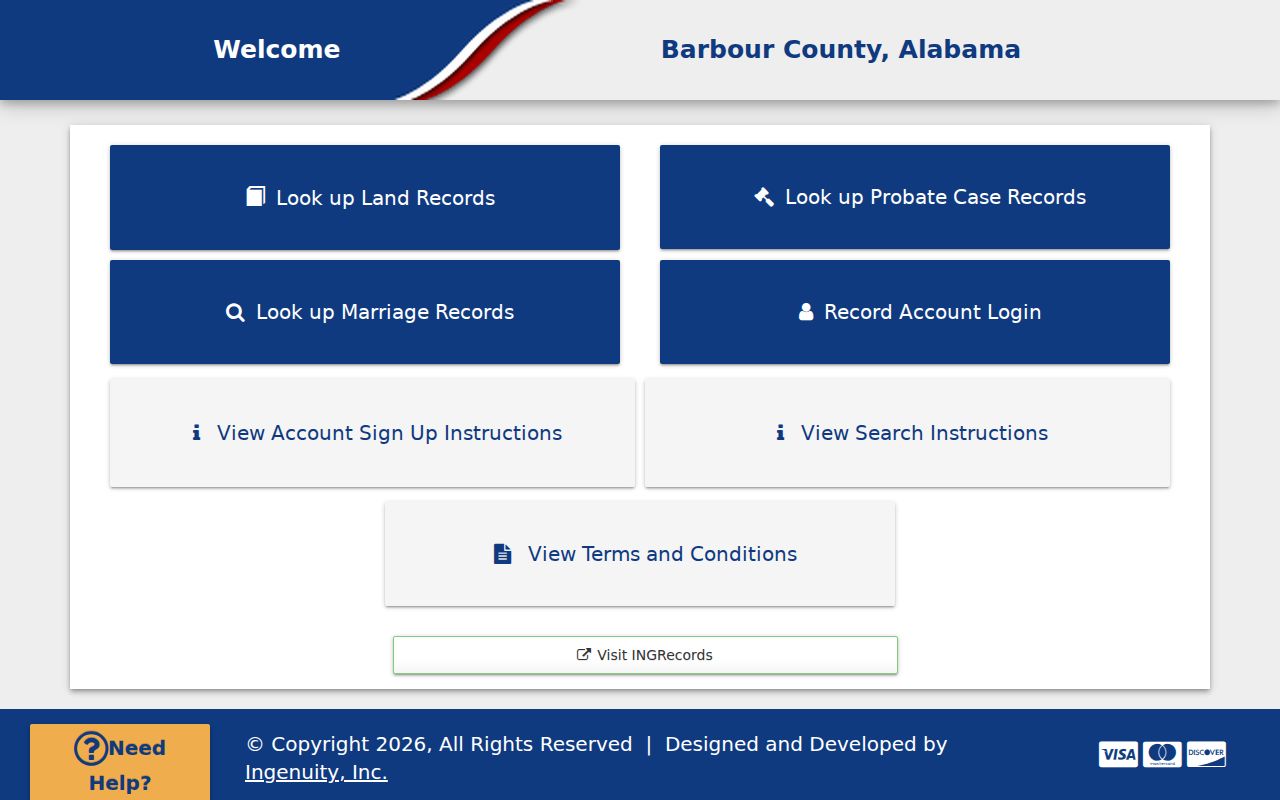
That screen is a doorway, not proof. Every deed book may not have an image, so keep the Probate counter, deed books, and archive routes in the workflow when an old citation is missing.
Walk Barbour's Grantor-Grantee Chain
A grantor gives up an interest. A grantee receives it. A chain of title links every instrument touching the same land. Start with the newest deed reference, then read each instrument for its prior source, parties, legal description, and cross-references.
- Take the current owner and deed book/page from CAMA or the latest known instrument.
- Search that owner as grantee and compare the parcel's legal description.
- Record the grantor, date, book/page, instrument type, and all indexed parties.
- Search the grantor as an earlier grantee, widening names and dates when needed.
- Repeat backward while checking plats, corrections, releases, estates, and court orders.
- Book/Page
- A volume citation for a recorded document.
- Instrument number
- A unique recording identifier.
- Cross-reference
- A pointer to another filing, such as a correction or release.
Names alone prove nothing. Continuity needs checking. Compare the land description at every step, since an estate, trust, entity, life estate, or survivorship interest can put several parties in one image even when the tax roll shows a single name.
Online Barbour Years Are Unstated
The portal names no starting year. Full image coverage is not guaranteed either. An empty online result never proves a complete historic chain is absent. Older research shifts to the Probate counter, deed books, indexes, and archive or library sources.
FamilySearch catalogs Barbour deed and conveyance material from the nineteenth and early twentieth centuries, though reel and image access varies. Its estate-case listings run about 1820 through 1918. The index reaches 1915 across 77 reels. Probate originals, Alabama Archives, university maps, and newspapers can add supporting clues to a Barbour County property search.
Barbour Courthouses Shaped Access
Barbour County dates to 1832. Its first courthouse was a log building. A brick courthouse followed in 1854 and was remodeled in 1924. After an 1879 compromise, courts operated in both Clayton and Eufaula. A modern Clayton courthouse arrived in the 1960s.
That split explains why an old deed, estate reference, or physical index may sit with Clayton in one source and Eufaula in another. Alabama Archives lists Barbour among counties with courthouse fires. Ask about gaps rather than assuming a destroyed decade of property records.
Barbour Mortgage and Lien Trail
A deed chain misses some burdens. Search mortgages, assignments, satisfactions, easements, judgments, hospital liens, mechanics liens, lis pendens, and foreclosure instruments in Barbour County deed records. Releases must match their claims. Parties, book and page, or cross-reference should line up.
Some disputes spawn a Circuit Clerk case, where the court file holds pleadings and orders beyond the recorder's indexed notice. Sealed or protected material stays private. The local clerk and the fee-based statewide court portal remain separate channels for a Barbour County property search.
Current Barbour eRecording Rules
CSC's January 2025 bulletin for Barbour County confirms that electronic recording is available. Recording hours run 9:00 a.m. to 4:30 p.m. Submissions may go in at any time. They simply wait for the processing cutoff. The county indexes grantor and grantee for every deed and requires the consideration to appear.
Format rules for electronic documents are precise. Page one needs a three-by-three-inch space in the top-right corner. Other pages carry at least one-inch margins. Type must be no smaller than ten points. Paper is letter or legal, and the scan is 300 DPI. None of this changes when older books became searchable online.
Note: Recorder acceptance confirms filing only. It does not confirm the legal effect of any statement in the document.
Barbour Fraud Alert Status
Alabama's 2026 Property Protection Act allows each judge of probate to set up a free notification service for real-property owners. The service is free. Barbour County publishes no enrollment page. The Probate Office must confirm local enrollment before anyone treats it as active.
Where an alert program exists, it warns the owner of a filing tied to a chosen name or parcel. It stops nothing. An alert neither blocks recording nor decides validity. Compare any notice against the indexed instrument and call the recorder whenever a filing looks unfamiliar.
Obtain a Barbour Deed Copy
An ING result opens a book/page popup. You can place one page, selected pages, or a whole document into a cart. The portal then prompts for download after purchase. It emails a receipt or link, and may keep the item in My Documents. Public material lists no fixed Barbour image price and no local certified-copy schedule.
A plain image serves research well. A certified copy carries the custodian's certification, which matters wherever official proof is required. Confirm the fee, payment method, and delivery option before ordering. For older material, give staff the parties and an approximate date. Also provide the document type, book and page, and the legal description.
Recorded, not guaranteed. Recording gives public notice, but it does not prove that a signer held valid title or that no other claim exists.
Start with the general Barbour County property search. It can supply the parcel card and deed reference before any purchase. That one step lowers the chance of paying for the wrong instrument.
For mail or counter service, identify the grantor and grantee. Give the record type, the approximate date, and the book/page or instrument number. Include the legal description too. Say whether you need a plain image or a certified copy. When a result has several pages, confirm that exhibits and attached descriptions belong in the copy before paying.
Citations sometimes fail. Ask whether the volume uses another index, a different spelling, or a different party role. Historic deeds may carry initials, marital recitals, metes-and-bounds calls, or an old subdivision name. Estate and court transfers can sit under an executor, trustee, representative, sheriff, commissioner, or decedent. Archives, newspapers, maps, and probate files supply helpful variants. But the recorded book remains the source.