
Compare Barbour County Value Types
A Barbour County property value can be one of several figures. It may be the appraiser's estimate for taxes. It may be the fraction used at assessment. It may also be the amount recited when a deed records a transfer. The parcel card keeps these apart. It also splits land from improvements so the appraised total is easier to follow.
| Value | What It Is | Where |
|---|---|---|
| Appraised value | County estimate of fair and reasonable market value | CAMA assessment record |
| Assessed value | Appraised or current-use value multiplied by the class ratio | CAMA and Revenue Commissioner |
| Last sale amount | Consideration tied to a recorded transfer | Deed and CAMA sales area |
| Land and building | Components of the appraised total | Parcel card |
The assessed value is not the sale price. It is a tax figure computed under Alabama law. A recorded consideration amount can mislead too, since family transfers, estate conveyances, partial interests and corrective deeds all recite numbers that never tested the market. Copy the parcel number, class, assessment year and source beside every figure. Labels are everything. Without them, two correct numbers look inconsistent. A tax record shows the assessed base. An appraisal record shows full value. A deed shows consideration. None of these should quietly stand in for another when you search Barbour County property records.
Barbour Land and Building Totals
The inspected CAMA result breaks value into a land total and a building total. It also lists an overall appraised figure. One Eufaula sample carries land value but no building value at all. That is a warning against assuming every parcel card describes an improved home. A blank situs address can sit beside a perfectly valid parcel and valuation. Read acreage, improvement details, legal description and district before judging the subject. Rural Barbour land leans on acreage, forestry and current-use fields. City lots turn on subdivision, lot and block.
Alabama Ratios Shape Barbour Values
Alabama applies class ratios when it converts a property's appraised value into an assessed value. Under the state's assessment rules, Class I property is assessed at 30 percent of value. Class II is assessed at 20 percent, Class III at 10 percent, and Class IV at 15 percent. Most owner-occupied homes sit in Class III. Much of Barbour County's farm and timber acreage lands there too. That happens when statutory conditions are met.
Estimate a Barbour County Value
Pull the official Barbour County record first. Note the tax values and the year they apply to. Keep any market estimate apart from what the deed records and tax roll actually say.
- Search the Barbour CAMA portal by situs address or exact parcel.
- Record the year, land total, building total, appraised total, assessed value and class.
- Open the Sales area and deed reference for transaction context, without treating consideration as an appraisal.
- Check current-use status or another classification before comparing the parcel with nearby land.
- Assessed value
- The value after the class ratio is applied.
- Appraised value
- The county's fair and reasonable value estimate.
- Assessment ratio
- The class percentage used to derive assessed value.
- Consideration
- The amount or value stated for a transfer, which may not equal market price.
- Reassessment
- A new review of the property's value for assessment.
Current Use in Barbour County
Some Class III land qualifies for current use assessment in Barbour County. This covers agricultural, forest, and related property. It can then be taxed on its current use rather than its fair-market value. The gap between the two figures can be wide. Treat it as a product of the statute, not a mistake. Wait until the property records confirm the status.
Barbour's Land Search tool helps here. Its Method, Forest Land, Schedule, Unit Price, and Unit Quantity fields show how a rural parcel's land value was built. That figure stays separate from any buildings on it.
That distinction matters locally. A wooded tract is listed by acreage and section-township-range. It does not match a platted lot in town. Check the valuation method, land schedule, and property class on the county's GIS map and tax roll. Do this before treating an assessed value as market.
Barbour's Seven Percent Cap
Alabama law now restrains how fast a taxable assessed value can climb. Under Act 2024-344, Class II and Class III property in Barbour County cannot see that measure grow more than 7 percent in a year. The growth is measured from the statutory base and subject to listed exceptions. The DOR cap explanation spells out how the rule applies.
The cap has limits of its own. It does not bind market value. It says nothing about what Barbour County land might fetch at a sale. Only the taxable assessed measure is restrained. New construction, a change in ownership, or other exceptions can still shift the outcome.
Sale Amounts in Barbour Records
Two Barbour County sources hint at what a property actually traded for. CAMA's Sales area pairs with the Probate deed. The deed itself carries the date, grantor, grantee, instrument type, capacity, and legal description alongside the amount. Not every deed reflects an arm's-length sale, though. Nominal, family, estate, foreclosure, partial-interest, and corrective conveyances can all mask the true price.
The deed book-page cited in CAMA leads to the recorded image itself. For copy mechanics, the Barbour County deed records page covers retrieval. This comparison stays on what the amount means.
A single sale is a poor stand-in for today's market. Improvements may have changed since the deed was filed. A tract may have been split. The rights conveyed may also differ from a full fee. Confirm the same legal parcel transferred and that any building was included. Remember that a recorded deed date marks a historical point. An appraisal carries its own effective date.
Historic Context Changes Comparison
Improvement context varies widely across Barbour County. Eufaula's Lore/Irwinton Historic District holds roughly 942 properties, about 738 of them contributing. But a district label alone settles nothing about value. Clayton and Clio grew along different historic and development lines. Each parcel's improvements, land, condition, and use must come from the record itself.
The numbers prove the point. One county sample shows just $800 in land and no building value at all. Another official Eufaula property-style record lists $6,000 land and appraised value. It leaves the property address blank. Figures like these only make sense when kept tied to their record date and parcel facts.
See Barbour's Value Record
The official sample CAMA record shows how land, building, appraised, and deed fields share one parcel card.
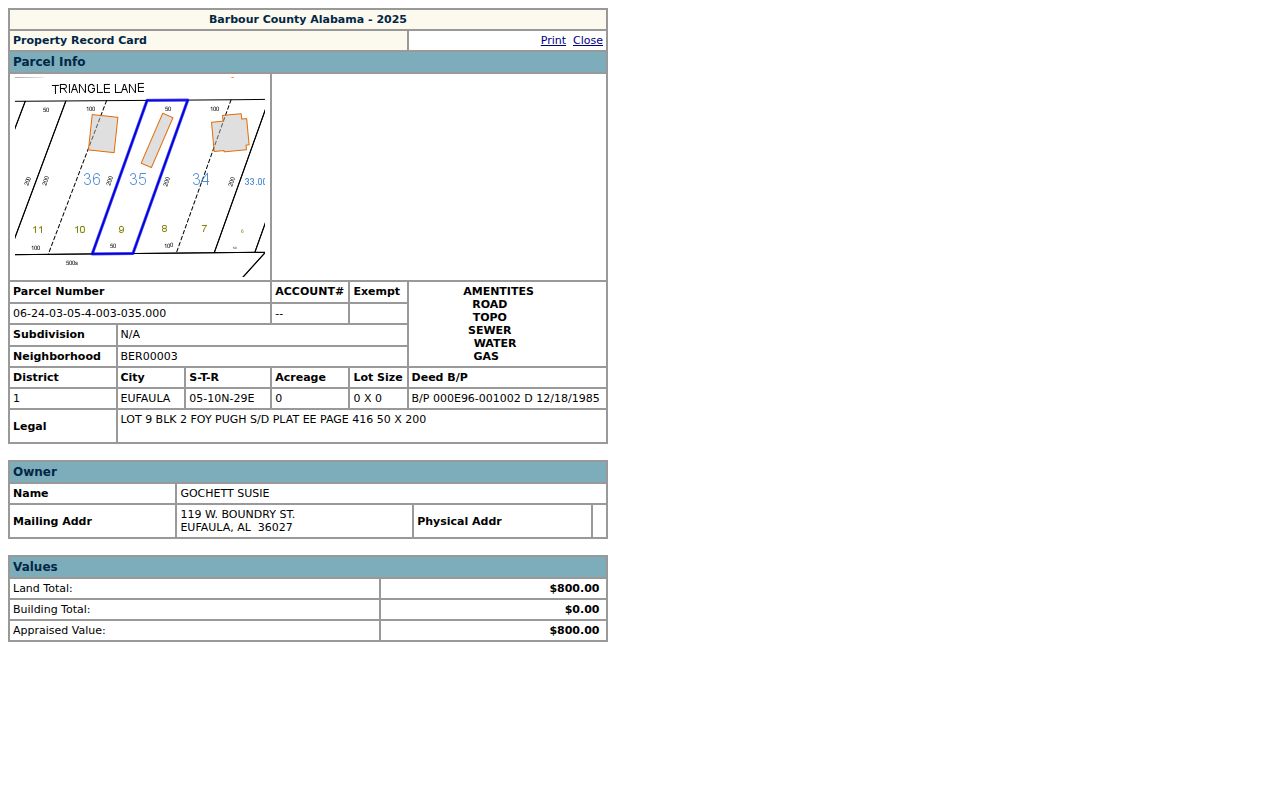
The official screens make the point plain: every value figure sits beside parcel identity and deed context. Never copy one without that context.
Barbour Property Value Limits
Barbour County's appraised and assessed values exist to support tax administration and nothing else. A county figure is not a private appraisal. It is not a promise of sale proceeds, or proof of insurable replacement cost. A licensed appraiser weighs the assignment, the date, and the property. The market evidence also matters before offering any opinion.
The county publishes no fixed calendar for CAMA refreshes. Note the assessment year and deed date. For tax bills, exemptions, and protest steps, rely on the Barbour County property tax records material instead. Do not convert a value comparison into a bill calculation.
A mismatch usually starts close to home. Confirm the parcel, the district, and the improvement record first. The Revenue Commissioner's appraisal contacts serve both Eufaula and Clayton. Ask which year's value the screen displays. Ask whether current use applies. Also ask whether a recent deed or building change has entered the roll. That fact check is not a formal appeal.
The online pages are public, but the county publishes no separate certified-record fee schedule for Barbour. Ask about the current charge and payment method. When a value document is not online, the local open-record process requires a specific request. It also requires proof of Alabama residency. Administrative fees may be estimated before work begins.
Value versus price. A Barbour County assessed value is for taxation. It does not state what the property would sell for and is not an appraisal.