
Find Who Owns Barbour Property
Work from address to CAMA parcel to displayed owner. Then confirm with the newest Probate instrument. The Barbour CAMA search accepts location, owner, mailing address, parcel, district, deed book and page, and deed date, with location pointing to the physical site as the cleanest start.
- Search the situs address in CAMA and open the parcel card.
- Copy the owner, parcel ID, deed book/page and legal description, then confirm the latest deed in ING Probate.
- If the grantee is an LLC, use the Alabama Secretary of State entity record to understand the entity name and status.
- Write down the date of each source. A recent deed may precede the CAMA roll update.
Barbour Property Owner Sources
Three official sources split the question of ownership. CAMA handles assessment, Probate preserves conveyances, and GIS supplies the map context.
| Source | Owner Info It Gives | Access |
|---|---|---|
| Revenue Commissioner CAMA | Current Owners, mailing address, parcel and deed clue | Public web search |
| Probate deed index | Grantee, grantor, date, type and book/page | Search plus account/cart image access |
| Secretary of State | Entity name, status and filing context | Public entity search |
| GIS parcel viewer | Parcel ID, shape and location context | Public map |
The owner of record may be an individual, joint owners, a company, a trust, or an estate. Mailing addresses can sit in another state. That address is a tax-roll contact. When dates conflict, check the newest recorded conveyance first, then ask Revenue staff whether the roll has caught up with it.
Barbour CAMA Owner Clues
The Current Owners area names the tax owner and mailing address. An instrument number sits beneath it. That number can lead toward deed records. Owner History adds prior names and addresses. These clues help anyone finding who owns a Barbour County property, though CAMA does not publish how fast the owner fields refresh after a new deed is recorded.
- Owner of record
- The name currently carried by the official record being viewed.
- Grantee
- The party receiving an interest in a recorded deed.
- Vesting
- The way title is stated to be held in the deed.
- Situs address
- The physical property location, distinct from an owner's mailing address.
Open the official Barbour sample parcel card to see owner, parcel, mailing, deed, and legal-description fields gathered in one place.
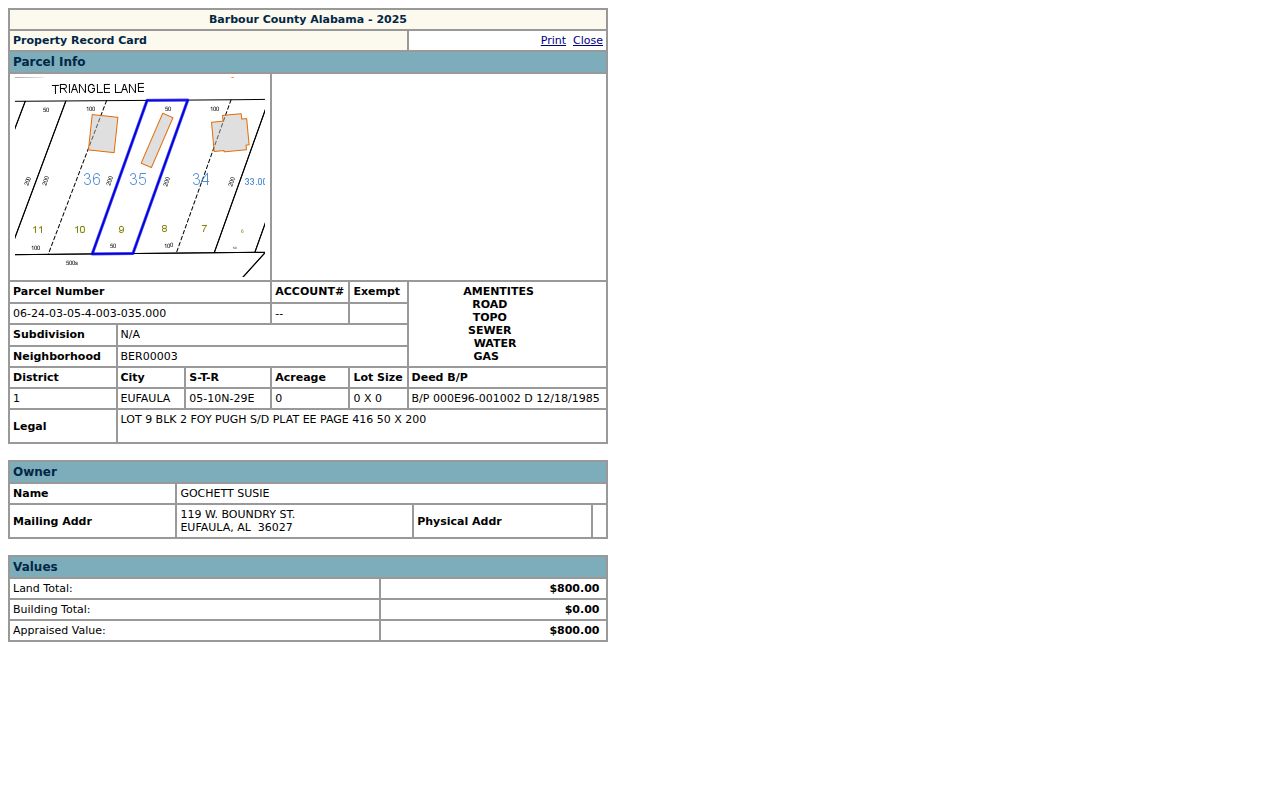
The sample card shows a single parcel ID anchoring the displayed owner to a deed reference and a land description, so no field floats free.
Other CAMA tabs can test a result without replacing deed confirmation. Owner History may show a prior entity and address. Assessment and Sales explain when a name changed. Legal keeps the matching land description. Maps highlights the parcel. Together these tabs can expose a name variant, a parcel change, or a likely update lag.
Exact keys matter. District, S-T-R, deed book and page, and the legal description all point to one assessment unit. One owner may hold several Barbour parcels. The legal description and parcel ID keep a deed for one tract from attaching to another, so copy the full suffix and every leading zero rather than shortening the number.
Barbour Owner Address Differences
CAMA treats Location and MailAddr as separate search keys. Location is the situs street. MailAddr is the tax-roll mailing street, linked in CAMA help to the most recent deed affecting the parcel. A mailing address can lie in another city or state, and vacant or rural land may carry no situs at all.
This gap feeds a common myth. The person there is not proved to occupy it. A blank street does not make the land ownerless. When a street query fails, try the parcel number, legal description, owner spelling, or deed book and page instead.
Confirm Barbour Property Ownership
The Probate Office records the instrument that transfers or burdens title. Its ING search instructions support name, date, book and page, party role, and instrument type. Images may require an account or cart payment. The public pages state no firm start year. Start from the parcel card's deed reference as a narrow route into the index.
Read the grantee name and the legal description. Note the execution and recording dates and the vesting language. Then look for later corrective deeds, estate instruments, or assignments that touch the same land. That sweep settles the chain. For present-owner detail, the Barbour current owner record focuses on reconciling CAMA with the latest deed.
Party-role filtering earns its keep. One surname can appear as grantor on a deed. It can show as grantee on another, and as borrower on a mortgage. Start with the book and page from CAMA. Widen by name variant and date from there. Images may be account or cart based. The Probate counters in Clayton and Eufaula remain the fallback, and Probate publishes no certified-copy price online.
The portal names no complete online start year. A missing older deed proves nothing about recording. Ask Probate about the book and index, then use documented FamilySearch and archive channels. Keep the parcel description beside the old names. A changed street or tax key then cannot break the trail.
Barbour LLC and Estate Owners
A parcel vested in an LLC or corporation calls for a different step. Search the exact grantee name in the Alabama business entity records. The result shows status, formation details, and any agent or officer, where available. Keep perspective here. An entity filing describes the business, not the land. The deed still controls, and only a recorded deed vests the parcel in the entity.
Estates raise their own trail. You may need a Probate case, a fiduciary deed, a court order, and a later CAMA update before the roll catches up. FamilySearch catalogs Barbour estate case files from about 1820 to 1918, with an index through 1915. Current cases go through Probate access. Match the decedent, the fiduciary, and the legal description. A shared surname proves nothing on its own.
Trusts create a similar name problem. The tax roll may show a trust, a trustee, or a shortened entity name, while the deed states the capacity in which someone took title. Search each recorded form. Compare the vesting language closely before you treat any name as the owner of record.
Recent Barbour Owner Changes
There is no official count. The days between a recorded deed and the tax roll update are simply not tracked anywhere. For a recent closing, compare dates in a set order. Start with the newest Probate instrument. Check any correction or estate filing next. Then read CAMA Current Owners, CAMA Owner History and Sales, and finally GIS. The map comes last because it is a spatial reference, not title evidence.
The 2026 Alabama Property Protection Act lets a judge of probate set up a free owner-notification service. It also creates a state title-fraud recovery framework. Barbour has announced no signup page or start date. Confirm any county service directly. Never pay a private solicitation that claims to monitor your deed.
Limits of Barbour Owner Searches
Public records can name an owner of record. They cannot prove occupancy, authority to sell, freedom from liens, or clear title. Alabama law allows protected, sealed, or redacted information to be withheld. A trust may list only a trustee. A business name may require separate entity research before the ownership picture is complete.
Lawful use. Use Barbour owner records for property research, purchase review, estate work and civic checks, never to stalk, harass or harm a person.
Treat the map as a locating aid only. It confirms you have the right parcel, nothing more. For a purchase, an estate, or a boundary dispute, pull the actual recorded documents. Get sound title advice too. The Barbour County tax roll is strong for finding land. But it is not a guarantee that every recent transfer has posted yet.
When a county record simply is not available online, Barbour's open-record procedure offers another path. It asks for a specific written request, proof of Alabama residency, and submission through the designated County Commission route. The procedure cannot conjure a record that does not exist. It also cannot force release of one the law keeps nonpublic.
A strong request speeds everything up. Name the exact parcel, any owner name variants, an instrument clue, and a date range. Ask for an existing index entry, a document, or an administrative record. Do not ask county staff to settle who owns the land. Barbour's procedure permits estimated administrative fees. It also requires advance payment whenever a search is expected to exceed eight staff hours. Unsolicited electronic requests go unacknowledged under the county process. So use the designated in-person or mail route and keep proof of submission.
Some records can lawfully be sealed, redacted, or withheld. A protected personal detail and a public owner of record name are different things. Where safety is a concern, ask the records custodian about any statutory protection that applies. Assume no online opt-out can erase a government deed or tax record. Barbour County offers no special confidential-address signup. Official parcel and deed records remain the right route to ownership answers. Use them with restraint and for a lawful property purpose.